Understanding NERC Regions and Maps

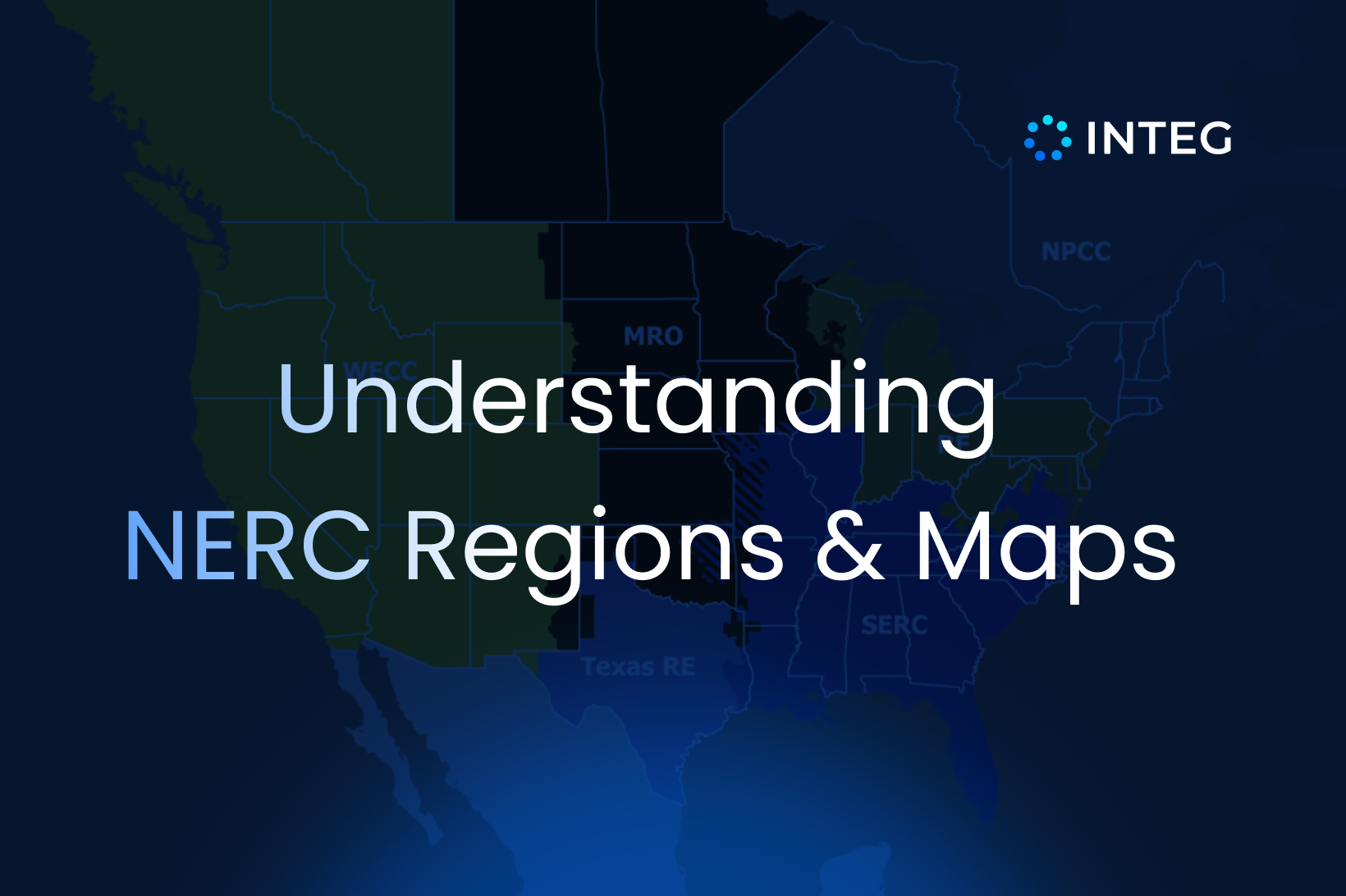
Your generating unit’s position on the NERC regional map determines who audits you and which enforcement staff review your self-reports. It also determines which Compliance Enforcement Authority conducts a spot check. For a fleet spanning multiple NERC regions, different Compliance Enforcement Authorities monitor the same PRC or TOP requirement. Knowing exactly which of the six regional entities holds delegated authority over each registered asset is the first fact of any compliance program.
What are NERC regions
NERC regions are the six geographic jurisdictions through which the North American Electric Reliability Corporation monitors and enforces mandatory reliability standards on the bulk electric system.
The statutory origin
Congress created the Electric Reliability Organization (ERO) framework through Section 1211(a) of the Energy Policy Act of 2005, which added Section 215 to the Federal Power Act, codified at 16 U.S.C. § 824o. FERC certified NERC as the ERO on July 20, 2006 in Docket RR06-1-000.
Mandatory NERC reliability standards took effect on June 18, 2007, after FERC Order No. 693 approved 83 of 107 proposed standards.
Why NERC delegates to regional entities
NERC does not audit most registered entities directly. Under 18 CFR Part 39, the ERO may delegate authority for enforcing reliability standards to a Regional Entity, and no delegation agreement takes effect until FERC approves it.
Geographic delegation exists because a continental bulk power system with thousands of registered entities cannot be monitored from a single office. Each regional entity administers audits and spot checks within its own footprint and carries out enforcement there. NERC oversees the regional entities, and FERC oversees NERC.
The statute reaches every participant. Section 215 states that “All users, owners and operators of the bulk-power system shall comply with reliability standards that take effect under this section,” per FERC’s Order No. 693 rulemaking.
How NERC regional oversight works
NERC delegates compliance monitoring and enforcement to six regional entities through FERC-approved Regional Delegation Agreements. Each regional entity administers the NERC Compliance Monitoring and Enforcement Program (CMEP) over registered entities within its geographic or electrical boundaries, and NERC and the regional entities assign each asset to an oversight entity based on those boundaries rather than its corporate headquarters.
The six current regional entities
The current structure has six regional entities, each operating under an Amended and Restated Delegation Agreement effective January 1, 2026 with a five-year term:
| Full name | Abbreviation | Geographic coverage |
|---|---|---|
| Midwest Reliability Organization | MRO | Saskatchewan and Manitoba; all or parts of 16 states from Montana and the Dakotas through the central corridor to Texas and Louisiana |
| Northeast Power Coordinating Council | NPCC | Seven Northeastern U.S. states and four Canadian provinces |
| ReliabilityFirst Corporation | RF | Mid-Atlantic and lower Great Lakes states plus the District of Columbia |
| SERC Reliability Corporation | SERC | The Southeast, including all of Florida, plus portions of the central and mid-South states |
| Texas Reliability Entity | Texas RE | The ERCOT interconnection within Texas |
| Western Electricity Coordinating Council | WECC | The Western Interconnection: 14 western states, two Canadian provinces, and northern Baja California, Mexico |
Geographic boundaries by state and province
State lines do not define NERC regions cleanly; most regions cover “all or portions” of their listed states, and the delegation agreement exhibits are the controlling boundary documents. The current breakdown:
- MRO covers Saskatchewan and Manitoba plus all or parts of Arkansas, Illinois, Iowa, Kansas, Louisiana, Michigan, Minnesota, Missouri, Montana, Nebraska, New Mexico, North Dakota, Oklahoma, South Dakota, Texas, and Wisconsin. MRO’s 2026 regional risk assessment lists this footprint.
- NPCC covers Connecticut, Maine, Massachusetts, New Hampshire, New York, Rhode Island, and Vermont, plus New Brunswick, Nova Scotia, Ontario, and Québec. NPCC lists this footprint.
- RF covers all or portions of Delaware, New Jersey, Pennsylvania, Maryland, Virginia, Illinois, Wisconsin, Indiana, Ohio, Michigan, Kentucky, West Virginia, Tennessee, and the District of Columbia. ReliabilityFirst’s 2026 business plan defines this coverage.
- SERC covers all of Alabama, Florida, Georgia, Mississippi, North Carolina, and South Carolina; most of Arkansas, Kentucky, Louisiana, Missouri, Tennessee, and Virginia; and portions of Illinois, Iowa, Oklahoma, and Texas. The NERC-SERC delegation agreement defines this footprint.
- Texas RE covers the ERCOT interconnection, roughly 90% of Texas’s electric load and 75% of its land area. The Texas RE delegation agreement defines the boundary by each registered entity’s interconnection with the ERCOT system as NERC records it in the NERC Compliance Registry.
- WECC covers all or portions of Arizona, California, Colorado, Idaho, Montana, Nebraska, Nevada, New Mexico, Oregon, South Dakota, Texas, Utah, Washington, and Wyoming; British Columbia and Alberta; and northern Baja California, Mexico. The NERC-WECC delegation agreement defines this footprint.
The Canadian interface works province by province, not uniformly. NERC describes its standards as mandatory and enforceable in eight provinces, with provincial regulators holding ultimate enforcement authority in most of them. Prince Edward Island and Newfoundland and Labrador remain outside active NERC compliance monitoring.
Nova Scotia’s 2024 legislation authorized adoption and monitoring. It also authorized enforcement, but implementing regulations remained pending as of April 16, 2026, so formal CMEP activity under the new regulatory structure had not begun.
In Mexico, Baja California Norte sits within WECC’s footprint, but the NERC 2026 business plan states that starting in 2025, NERC, WECC, and WIRAB will not assess Mexico until a new agreement is reached.
The three North American interconnections
NERC aligns WECC and Texas RE with their respective synchronous interconnections while dividing the Eastern Interconnection among four regional entities. North America runs on three major synchronous interconnections, per EIA:
- Eastern Interconnection: everything east of the Rockies except most of Texas, containing 36 balancing authorities (31 U.S., 5 Canadian). MRO, NPCC, RF, and SERC all operate here.
- Western Interconnection: the Rockies west, containing 37 balancing authorities (34 U.S., 2 Canadian, 1 Mexican). WECC is its single regional entity, and its territory is the interconnection itself.
- ERCOT Interconnection: most of Texas, operating as a single balancing authority. Texas RE is the corresponding regional entity. ERCOT combines the balancing authority and interconnection functions, and the same organization also serves as the RTO for that physical system.
The Québec Interconnection connects to Ontario, New York, New England, and the Maritimes through HVDC ties, as documented in NERC’s 2025 summer reliability assessment, and falls within NPCC’s region. This physical layout explains why WECC and Texas RE map one-to-one with their interconnections while four regional entities share the Eastern Interconnection.
Regional Delegation Agreements and enforcement
Each delegation agreement authorizes the regional entity, acting as Compliance Enforcement Authority (CEA), to run the CMEP defined in Appendix 4C of the NERC Rules of Procedure, effective May 19, 2022. The monitoring tools that reach your program directly:
- Compliance audits. Regional entities may audit every registered entity for standards applicable to its registered functions. Regional entities must provide at least 270 days’ notice of a scheduled compliance audit, and the CEA may initiate an unscheduled audit at any time it reasonably determines necessary.
- Spot checks. The CEA initiates spot checks at its discretion or when NERC directs it to do so.
- Self-certifications. The CEA provides at least 60 days’ notice for required self-certifications.
- Periodic data submittals and complaints. Data submittals follow reliability standard schedules. The CEA may receive and act on complaints alleging violations.
When a regional entity identifies potential noncompliance, the enforcement path follows this sequence:
- Preliminary screen. The CEA conducts a preliminary screen within 10 business days and then assesses risk.
- Risk disposition. The CEA resolves minimal-risk noncompliance as a Compliance Exception, which does not enter the registered entity’s compliance history for penalty purposes. It may resolve minimal-to-moderate-risk noncompliance through Find, Fix, Track and Report. In 2025, CEAs made those dispositions: approximately 83% of processed noncompliance resolved as Compliance Exceptions and 14% as FFTs.
- NAVAPS response. When CE or FFT treatment is inappropriate, the CEA issues a Notice of Alleged Violation and Proposed Penalty or Sanction. The registered entity has 30 days to choose a response:
- Accept the determination.
- Contest the determination.
- Enter settlement negotiations.
- FERC filing. NERC files the Notice of Penalty with FERC. Under 18 CFR § 39.7, the penalty takes effect no earlier than the 31st day after filing; absent a review application or Commission action, FERC affirms it by operation of law.
NERC also audits how each regional entity implements the CMEP at least once every five years. Penalty exposure is rising: the ERO Enterprise began a four-year inflation phase-in in 2026, increasing penalty amounts 15% per year through 2028, with an assumed 2026 maximum civil penalty of $1,625,849.
Key features and capabilities
Regional oversight in practice means the CEA in your footprint monitors your registered functions against every applicable standard family. NERC’s standards numbering system defines 14 families. The ones that dominate generation-side compliance work are PRC (Protection and Control) and TOP (Transmission Operations). They also include MOD (Modeling, Data, and Analysis) and CIP (Critical Infrastructure Protection). Each standard defines its own applicability.
| Standard | Applies to |
|---|---|
| Transmission Operations standard TOP-001-6 | Transmission Operators, Balancing Authorities, Generator Operators, and Distribution Providers |
| Modeling, Data, and Analysis standard MOD-032-2 | Planning Coordinators, Transmission Planners, Balancing Authorities, Generator Owners, Transmission Owners, Distribution Providers, Resource Planners, and Transmission Service Providers |
| Protection and Control standard PRC-019-3 | Generator Owners and Transmission Owners only |
The registered entities carrying these obligations span investor-owned utilities, cooperatives, federal power agencies, independent power producers, and load-serving entities. NERC assigns registration by function code: Generator Owner, Generator Operator, Transmission Owner, Transmission Operator, Balancing Authority, Distribution Provider, and others that NERC defines in its registry criteria, effective June 27, 2024.
Generator thresholds matter for portfolio planning. An individual unit above 20 MVA at 100 kV or higher, or a plant aggregate above 75 MVA at 100 kV or higher, triggers registration. So does a Category 2 non-BES inverter-based resource of 20 MVA or more at 60 kV or higher.
Regional entities also participate in writing the standards they enforce. NERC’s standards development runs through a Registered Ballot Body organized into ten segments under Appendix 3D:
- Transmission owners
- RTOs and ISOs
- Load-serving entities
- Transmission dependent utilities
- Electric generators
- Brokers and marketers
- Large end users
- Small users
- Government entities
- Regional entities (Segment 10)
Approval of a standard requires a 75% quorum and a two-thirds weighted supermajority across segments under the Standard Processes Manual.
How NERC regions fit in
NERC regions vs. ISO/RTO footprints
NERC regions are compliance jurisdictions; ISO/RTO footprints are market and operational jurisdictions, and the two maps do not align. Regional entity assignment follows NERC registration and functional reliability responsibility. ISO/RTO assignment follows transmission control and tariff administration, as well as market participation.
The overlaps are routine:
- MISO operations fall within three regional entities, SERC, MRO, and ReliabilityFirst.
- PJM spans RF plus SERC through the Dominion transmission zone.
- SPP, whose eastern footprint sits under MRO and SERC, expanded into the Western Interconnection on April 1, 2026, becoming the first RTO spanning two interconnections, with its seven western states under WECC.
A generator can answer to one regional entity for reliability compliance and a different organization entirely for dispatch and settlements.
Balancing authorities
Balancing authorities are a third, distinct layer. They balance load and generation in real time and hold registered functions subject to NERC standards.
The E-ISAC is not a regional entity
Industry readers also frequently confuse the E-ISAC with regional oversight, and the distinction has teeth. NERC operates the Electricity Information Sharing and Analysis Center for threat intelligence sharing and security analysis, serving more than 1,900 member and partner organizations. It holds no enforcement authority.
The Code of Conduct establishes two key prohibitions:
- E-ISAC personnel may not convey protected possible-violation information to the CMEP.
- CMEP personnel may not access the E-ISAC Portal.
The protection does not cover information that NERC standards or law separately require, that CMEP personnel discover through monitoring, that public sources disclose, or that an entity reports through another channel.
eGRID subregions are not NERC boundaries
One more boundary trips up anyone pulling emissions data: EPA’s eGRID subregions are not NERC regional entity boundaries. eGRID2023 organizes plant data into 27 subregions and a separate nine-category “NERC region” aggregation tier that still includes FRCC, a regional entity dissolved in 2019. Use eGRID for emissions factors; use the delegation agreements for compliance jurisdiction.
How NERC regions have changed
Today’s six NERC regions are a consolidation of the eight regional entities FERC approved in its April 19, 2007 delegation order: FRCC, MRO, NPCC, RFC, SERC, SPP RE, Texas RE, and WECC. Two have since dissolved.
- SPP RE dissolved in 2018. FERC approved the dissolution on May 4, 2018 in Docket RR18-3-000, and 122 registered entities transferred on July 1, 2018, 109 to MRO and 14 to SERC, with one entity registered in both. SPP RE formally dissolved August 31, 2018.
- FRCC dissolved in 2019. A FERC letter order (167 FERC ¶ 61,095, Docket RR19-4-000) approved the dissolution on April 30, 2019; 36 registered entities transferred to SERC on July 1, 2019, and SERC hired the remaining FRCC staff and absorbed its records.
The August 14–15, 2003 Northeast blackout cut power to an estimated 50 million people and 61,800 MW of load across eight states and Ontario. That event traces directly to the mandatory framework these entities enforce today.
The joint U.S.-Canada Task Force’s final report, issued April 5, 2004, identified seven violations of then-voluntary NERC standards and made 46 recommendations. Its single most important recommendation was that Congress make reliability standards mandatory and enforceable. Sixteen months later, EPAct 2005 did exactly that.
The consolidation history matters when you read older filings. A violation record, RSAW, or registration document referencing FRCC or SPP RE predates the 2018-2019 transfers; the successor entity for both populations is now SERC or MRO, and legacy pre-2006 council names such as ECAR, MAAC, MAIN, and MAPP predate the ERO framework entirely.
NERC regional map and boundary resources
Boundary and GIS resources
- NERC Regional Delegation Agreements page: NERC’s Regional Delegation Agreements page hosts the six current agreements, each with a geographic exhibit that is the controlling description of the regional footprint.
- EPA eGRID mapping files: EPA’s eGRID mapping files provide shapefile downloads for the 27 eGRID subregions across editions back to 2014. KMZ and KML downloads are also available, with the caveat that eGRID boundaries are representational and lag regional entity restructuring.
- HIFLD Open / surviving NERC Regions polygon layer: The HIFLD Open program ended on August 26, 2025, but a surviving HIFLD-derived NERC Regions polygon layer remains available as an ArcGIS FeatureServer. It supports JSON and GeoJSON, with PBF also available.
No retrieved source confirms a currently active official standalone NERC-boundary shapefile from EIA or DHS, so treat third-party polygons as approximate and not suitable for legal or engineering purposes.
Running one evidence program across regions
Verifying the map is the easy half. The hard half is running one evidence program across multiple CEAs and registered assets. PowerCompliance automates evidence collection for PRC, TOP, and MOD requirements across source systems.
It maps each artifact to the specific standard and requirement it satisfies and tracks deadlines with built-in validation, so audit-ready documentation exists continuously instead of requiring assembly in the weeks before a regional review. To see how it handles your specific regional entity mix, schedule a demo with the Integ team.
FAQ
Which states are in each NERC region? Most states split across regions, so “all or portions” language governs. Broadly: MRO covers the upper Midwest and central corridor plus Saskatchewan and Manitoba; NPCC covers New England, New York, and four eastern Canadian provinces; RF covers the Mid-Atlantic and lower Great Lakes; SERC covers the Southeast including Florida; Texas RE covers the ERCOT interconnection; WECC covers the West plus British Columbia, Alberta, and northern Baja California. The geographic exhibits in each delegation agreement are authoritative for any specific asset.
What is the difference between a NERC region and an ISO/RTO? A NERC regional entity enforces reliability standards under authority delegated from NERC and under FERC oversight. An ISO/RTO administers transmission service and wholesale markets. One organization can sit inside several of the other: MISO alone crosses MRO, SERC, and RF.
How does NERC delegate enforcement authority? NERC executes Regional Delegation Agreements under 18 CFR § 39.8, and FERC approves each agreement before it takes effect. The regional entity then acts as Compliance Enforcement Authority within its boundaries. It audits and investigates registered entities. It also determines violations and proposes penalties, while NERC reviews its determinations and files notices of penalty with FERC.
How do NERC, FERC, and the Energy Policy Act of 2005 relate? EPAct 2005 added Section 215 to the Federal Power Act, creating the ERO framework. FERC certified NERC as the ERO in 2006 and retains oversight: it approves or remands standards, approves delegation agreements and budgets, reviews penalties, and can enforce standards on its own motion.
Which entity types must register for NERC compliance? Registration attaches to functions, not ownership structure: Generator Owners and Operators, Transmission Owners and Operators, Balancing Authorities, Distribution Providers, Reliability Coordinators, and planning functions among the 14 codes in NERC’s registry criteria. The organizations behind those registrations include investor-owned utilities, cooperatives, federal power agencies, independent power producers, and load-serving entities.
Related articles
Get a Demo

